Friday, October 10, 2008
We are all Angels: Yom HaKippurim
The Sfas Emes quotes the Gemara in Yoma that discusses the procedure of the Kohen Gadol before Yom Kippur. 7 days he separates from his wife and prepares for the one day. This is how the Sfas Emes connects Yom Kippur to being above nature Le'ma'ala min ha'teva, as 7 is nature, but 7 plus 1 is eight and that is above nature. How do we as Jews reach that level of Le'ma'ala min Ha'teva? The Sfas Emes says Fasting and Teshuva. Fasting because it is above our nature to not consume food and drink, and by doing this we are able to reach the level of angels, who not only do not eat, but do not want to eat. We wear white linen based off of Yehezkal's vision, we don't eat, and it is considered meritorious to stand as much as possible as the angels are incapable of sitting. Baruch Hashem I was blessed to stand the whole time except for the reading of Torah. We also become Korbanos as our bodies feed off of our fat and blood like that of the Korban of Yom Kippur.
How is Teshuvah above nature? The Sfas Emes explains that when we do something (like an averah) it becomes natural to us and very difficult to overcome. By doing proper Teshuvah we are able to raise ourselves above the natural process of everyday life. Hashem gives us the opportunity to obtain a higher level of spirituality on this day. This helps us with both these aspect of Yom Kippur and helps us in appreciating the importance of the day and the joy that these two elements should bring.
I held on to these ideas as I prayed to our creator and It was the most intense experience of my life. Not only did I completely ignore the Yetzar Hara who told my I was "starving", but I could have honestly fasted through the night until the morning. I was totally consumed in what I felt was proper Teshuva and striving for a connection with Hashem. There is something special about my parents shul, as its not a typical Chabad shul, its more like a Lubavitch Shtiebel. The Chazzan was a Rabbi from my community in Long Beach, and his voice is the sounds of a neshama trying to leave through the wind pipe. Im not so into the beautiful voice, I am into the powerful voice that cries when we pray that Hashem should have mercy and not take our lives before our time or when we speaks about the tragedy of the 10 martyrs.
Anu V'Ata was my climax, as that prayer gives me such intense concentration and passion. However the climax of climaxes was Shema x1 Baruch Shem x3 Hashem Hu x7. I lost my voice at Hashem Hu #7 and was shaking all over. We finished off right before the shofar with the Chabad Minhag of "the Victory March". Dancing Jumping Yelling around the Bimah I thought I was at a Breslov Shul for a moment.
I smiles, I cried, my soul was so joyful and I pray that my teshuva was sincere and accepted and that I can work to become a better Yid. Someone asked me last night if I made any resolutions. Jokingly I said, Yea not to make vows.
On a serious note, we should all focus on making our performance of mitzvos less routine and really pay attention to the fact that we are performing these mitzvos and although everyday, they are special and unique everyday. We should pay attention to our blessings over mitzvos and food and really be sincere. When someone does something for us we thank them and remember that. When we "forget" if we said a bracha rishon or achron, it is because we didn't properly thank Hashem for what he has given us.
May this year be the year that we grow and raise our spiritual level so that we can bring Moshiach speedily Amen!!!
Sunday, September 21, 2008
Wearing a Tallis during Selichos
The nusachs of davening Selichos are not like that of normal davening, as they are based on region instead, which still follows closely to normal nusachim. In respect to European Jews, Chassidim of Poland use Nusach Polin, Russian Jews like Chabad use Nusach Ruzin, Litvaks use Nusach Litva, and I'm sure Jews of Germany, Hungary use their own respective Nusachs.
There is a great difference between Selichos of Polish Chasidim and Chabad as Chabad does not put their head down. I'm used to being the lone Chasid doing things different but this was awkward and confusing enough for me to not put my head down. This is a mistake on my part that I will not repeat again iy"H.
Another interesting maklokes involves wearing a Tallis during Selichos. This is something most Jews do not do, but I will do. (I wasn't married during last selichos so I didnt have this issue to worry about). My Rav and I learned about Selichos from Sefer Nitei Gavriel, and he says explicitly that you must wear a Tallis if you recite Selichos at the earliest time (or later) to wear a Tallis, and if you are in the middle of reciting Selichos when that time arrives you must stop and put on your Tallis. I know I am going to get flack for this but I hold by how Rabbi Gavriel Zinner (author of Nitei Gavriel) poskins. He is a very respect Chassidishe Posek and if there is an issue the Lubavitch Shul I daven at owns his whole set. Generally Lubavitch Minhag and understanding of Halacha agree, but there are occasions when they don't, such as if one should not fast on his wedding day if it falls on Rosh Chodesh Nissan. This Maklokes in itself could have its own article, so I wont elaborate.
I will end with an amazing parable on Selichos given over by the Rebbe Reb Simcha Bunim of Peshischa. There once was a King who had a rebellious son, so he banished him from the kingdom. The prince came upon a rural village and soon he became more villager than prince. The king still loving his wayward son, would send out secret agents to check up on him and help him through difficult times without his knowledge. One day the king couldn't bare it and he sent a message to his son. The message said "Your father loves you and is ready to grant you anything you want. Make a wish." The son didn't have to think very long. "Tell my father how grateful I am for his concern. And them him that it is cold here and my coat is worn. Please ask him to send me a new, warm, fur-lined coat!"
Can one imagine the heartbreak of the father who wanted his son back in the Palace? The boy could have asked for a chance to visit his family. he could have asked for a reconciliation. He could have asked for the kingdom. But he had forgotten where he belonged. He had traded the palace for the corral, traded his destiny for a coat.
So too, R' Bunam said, "We come to the Days of Awe when G-d longs for us to say, 'Father, we want to come home to YOU!' And all we think about to ask for in our prayers is a bit more money, a nicer home, a warmer coat. Can we even begin to imagine the extent of our foolishness and the anguish we cause G-d?"
As i recited Selichos last night I was so overwhelmed at the words with this new thought in my head. It was one of the most intense moments of prayer I have experienced outside of Eretz Yisroel.
May we all be blessed to beg Hashem to let us come back home and become the princes and princesses that we as Children of Hashem are destined to be!!!
Thursday, September 18, 2008
No Tachnun
Today is a very special day for Chasidim. Today is Chai (18th of) Elul, and lots of amazing things happened to the Jewish people, especially the Chasidim. Today is the birthday of the Baal Shem Tov, Aka the Besht, Aka Rabbi Israel Ben Eliezer. It is also the day that Alter Rebbe of Chabad, Shneur Zalman of Liadi was born and also the day special Maamers and Chassidius given over through out their lives. Another notable event today, is the Yaharziet of the Heliga Maharal of Prauge, Rabbi Judah Loew ben Bezalel. This is where the Tachnun comes in, or rather doesn’t come in. As a general Chassidic Minhag that I have taken from my Rav, Tachnun is not said on the Yaharziet of Tzaddikim. This is not a Minhag of Chabad, as they even say Tachnun on their Rebbe's Yaharziets, or so I thought. No, it is not a Minhag of Chabad, but like all groups, you always have a rouge. I don’t mean that in a negative way, but it does make me smirk when someone steps out of routine and gets a comment out of the head Rabbi of my Shul.
There is a Chasid at my shul that does things that conflict with what other Chabad Chasidim feel should be done. One of those things is random times when Tachnun should be said and isn’t. Today is one of those days. The last one happened on the date marking the release of the Frierdiker Rebbe from Russian Prison. He was Shliach Tzibur and didn’t say Tachnun and this started a quiet argument as to "What the Rebbe did". Still, Tachnun wasn’t said. Today the Head Rabbi made an announcement, that "Today is Chai Elul, which is a very important day for Chassidim (Went on to list the reasons) and because of this Rabbi So & So probably wont be saying Tachnun, even though there is no source for this."
Now as a non Chabad Chasid davening in a Chabad shul, there are a few things I do different, and one of those is trying to not make it obvious that I'm not saying Tachnun. I have a calendar that is in the process of being marked on which days not to say Tachnun, because sometimes I forget and then realize later. I usually insert some sort of voluntary prayer that is printed after Shachris in the Art Scroll Sefard Siddur instead. Now don’t think I’m one of those Chasidim that goes No Tachnun Buck Wild. I only omit Tachnun when it is the Yaharziet of a Tzaddik who I have learned some sort of Torah from, not if I have just "heard of him".
This brings me to another interesting event that occurred today. Is it only Chabad or do other Chassidim consider Birthday, Yaharziet, or something monumental involving their Rebbes as Yom Tovim? The same Chasid, who doesn’t say Tachnun on these random days, also wishes everyone a "Gut Yom Tov", and wears his Kaputa. I only find this weird because he is the only one and no one else, not even the Head Shliach of the shul wears his.
Today we should learn Chassidus from the Besht, and the Alter Rebbe, as well as Chumash with Gur Aryeh (Maharal of Prague's commentary on the Chumash). May the merit of these Tzaddikim bring forth Redemption and Moshiach and may their Torah inspire us to engage in Tefillah, Teshuva, and Tzeddakah and be judged in favor by Hashem this Rosh Hashanah.
Thursday, September 4, 2008
Me'arat HaMachpela
Have you ever driven the streets of Los Angeles or Chicago or New York? Let me tell you about the time my wife and I dropped the rent check off in Inglewood. There are cities in America, and the world that are 10 times more dangerous to be in than Hebron. However, because of the media and hearsay, American Jews are panic stricken to go to Hebron.
I sometimes believed the distortion about Hebron, and how the Jews live in fear of the Arabs surrounding them. That was until my parents spent Shabbos in Hebron in the beginning of 2008. In 2005 my parents were taken to Hebron with their community Rabbi. They must have forgot to compare their Jewish Muslim calendars because he took them on the first day of Ramadan. Well after their group was surrounded by a potential mob of hundreds of muslims, they IDF swooped in surrounded the Jews and escorted them to the bus. Not the best idea, but like going anywhere you need to know where you are going and whats going on there. Visiting before Shabbos earlier this year my mother took a taxi with that community Rebbitzen and somehow were dropped off in front of the Palestinian Authority Headquarters and had to walk to their friends home in Kiryat Arba. Not the best idea but they traveled comfortable without any fear evoked by the Arabs living there.
With all this in mind, I traveled with my wife and our friend to Hebron. The bus was bulletproof and the drive into the West Bank was interesting. The view consisted of more than lots of checkpoints, fences, and walls. There were beautiful fields and vineyards and lots of green hills. The Torah says that Hebron, the least fertile area of Israel is seven times more fertile than than the most fertile land of Mitzrayim (Egypt). The bus winded down the narrow rubble filled streets of Hebron up to the military checkpoint. We got off and observe an IDF soldier with his M-16 drawn aimed in the direction of a house behind us. He starts yelling and I wasn't sure If I should run back onto the bus, or run to the Cave. Then he lowered his weapon and we became our walk to the Cave HaMachpela.
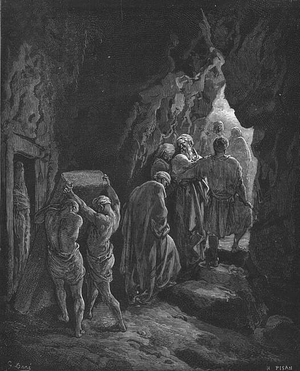
I don't think Ive ever seen photos of Me'arat HaMachpela but I knew there was a mosque there. An acquaintance of mine said that its overrated to go there and you feel like you are praying in a mosque and there is no holiness there. His words to me weren't even worth a grain of salt, more like a grain of sand but nothing would prepare me for my first view of the Caves. The mosque is huge, like a fortress, and it was very intimidating as I walked towards it. Once we got inside and saw the tombs I was in awe. Unless you are able to read Arabic, you would never know it was a mosque as Arabic looks like fancy artistic decoration. The holiness was like a weight on me leaving me in awe and my yetzer hara powerless over me. I davened mincha in the kever of Avraham Avinu and Sarah Emanu and it was one of the most joyous times of prayer I have ever experienced. There was an absolute connection between my sour and HaKodesh Barachu in the merit of our Father and Mother. After davening i said the prayer for when you visit Me'arat HaMachpela which brought me to tears as I stared at the Stone Marker of Avraham.
The whole experience was overpowering and so fulfilling for my soul. This experience I recommend for any Jew, especially one who is searching to connect closer to HaKodesh Barachu. Ignore what anyone tells you about the danger because Hashem will keep you safe on your journey and anyone that has actually been there can attest to the experience out waying the apparent risk of coming to Hebron. Chazel and any Chacham for that matter can attest to the benefit of visiting the graves of Tzaddikim, not just spiritually, but also physically. Hebron is a special place that will forever resonate in my heart and mind. I look forward to the next opportunity to visit such a holy place as Me'arat HaMachpela.
Next blog: Tzfas and the Holiest Mikvah on Earth.
Tuesday, July 8, 2008
Can the people praying keep it down there are people trying to talk.
During Shabbos davening at my parents shul the Rabbi stood up in the middle of davening and asked the congregation nicely if "the people praying could keep it down because there were people trying to talk." It got a mixed reaction. Some laughter, maybe some silence from the constant chatterbox's that plague Torah Observant Shul's worldwide. Ive been in shuls where the Gabbi said if you want to talk then go outside, and a group of around 10 people left. A full minyan decided that what they had to say to each other was more important that what they should be saying to Hashem.
Its something that unfortunately has becoming an accepted practice on Shabbos because "you kinda have to be there" but there are other times it just surprises me. Last night we had a 10pm maariv so that someone could say Kaddish. Not surprisingly, the two next to me finished Shemonah Esrei in 3 minutes flat but what was surprising was what they did when they finished. They started talking. Talking in the little Bies Midrash where everyone can hear you without a single care as to the disturbance they might be causing their fellow Yidden. It's not that I was truly distracted or even offended, I'm just surprised. I'm surprised that after reading Tanya probably fifty times over, they would have skipped the end where it discusses the Alter Rebbe of Chabad's view on davening. They spoke throughout Shemonah Esrei, in between the amens of Kaddish and since they said Aleinu right after Shemonah Esrei, they spoke through ours. Now like I said, "you have to be at shul on Shabbos" but you DON'T have to be at shul at 10pm for maariv as a favor for another Jew. Couldn't you talk after Maariv? The whole davening only lasted 15 minutes at best. Couldn't you have gone home and chatted on the phone? I got home at 9:00 and I was tired. I could have davened and went to bed, but I went to shul because I feel its important to daven with a minyan. What about you?
Its safe to say they weren't discussing a blot of Gemara they just couldn't decipher, or a Sefer that really has them boggled, or even some part of Tanya that has them perplexed. It was about sports, or movies, or just something "funny".
We arent on the levels of the original Chassidim or anyone before them and never will be. However that has now become an excuse for trying to raise up our spirits and devotion to G-d, because its HARD to do and with much more temptation than the Chassidim of the Baal Shem Tov, its easier to fall pray to the Sitra Achra.
How can I, a Baal Teshuva, with barely any yeshiva learning, with only a few years of devotion to Hashem have trust that after many years I will grow closer and closer to HaKodesh Barachu? When I see FFB's with Smicha who are a good 5-10 years older than me acting the way these two were acting I know Moshiach is coming because he will only come when people start forgetting Torah.
Its a total disrespect for Hashem's Presence, the Torah's Presence, & the Shuls Presence. Is it not a mitzvah to show reverence to the Sanctuary or did I confuse that with something else when I read the Chofetz Chaim's Book of Mitzvot.
I dont think I'm better than these people, in fact its the opposite. They are better than me, and when they act in a holy way which I know they can, they inspire me to raise myself up. Its when they think that Tivo-ing the Dodgers game is more important than praying to G-d that I just don't understand.
Someone once defended them by saying after decades of davening it becomes routine and that the more you learn the strong your Yetzer Hara becomes. Later I thought to myself, and the more you learn the more you understand how to battle the Yetzer Hara.
I pray to G-d that when I'm G-d willing 30 or 40 or 50 or 60 or 120!! I will always remember how important davening was to me when I was 23. Hopefully the Torah I learning from now till then will strengthen my devotion and not weaken it.
Tuesday, April 15, 2008
Davening with a Minyan
(Courtesy of www.xanga.com/