Thursday, September 4, 2008

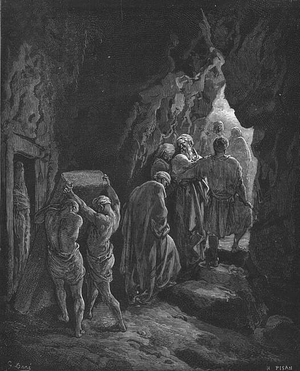
Me'arat HaMachpela

(painting by Gustave Doré)

Hebron is a very special city for us as Jews, and just like anything truly special to the Jews it is truly special to someone else. Me'arat HaMachpela has always been on my list of places to visit, but something always seems to get in my way. In 2000 just before the intifada we were unable to go and in 2006 during the Lebanon War, I was also told to stay away. Its to dangerous of a place they tell me. The violence between the Arabs and the IDF will put you in grave danger they say. Its just not safe, period I'm told.

Have you ever driven the streets of Los Angeles or Chicago or New York? Let me tell you about the time my wife and I dropped the rent check off in Inglewood. There are cities in America, and the world that are 10 times more dangerous to be in than Hebron. However, because of the media and hearsay, American Jews are panic stricken to go to Hebron.

I sometimes believed the distortion about Hebron, and how the Jews live in fear of the Arabs surrounding them. That was until my parents spent Shabbos in Hebron in the beginning of 2008. In 2005 my parents were taken to Hebron with their community Rabbi. They must have forgot to compare their Jewish Muslim calendars because he took them on the first day of Ramadan. Well after their group was surrounded by a potential mob of hundreds of muslims, they IDF swooped in surrounded the Jews and escorted them to the bus. Not the best idea, but like going anywhere you need to know where you are going and whats going on there. Visiting before Shabbos earlier this year my mother took a taxi with that community Rebbitzen and somehow were dropped off in front of the Palestinian Authority Headquarters and had to walk to their friends home in Kiryat Arba. Not the best idea but they traveled comfortable without any fear evoked by the Arabs living there.

With all this in mind, I traveled with my wife and our friend to Hebron. The bus was bulletproof and the drive into the West Bank was interesting. The view consisted of more than lots of checkpoints, fences, and walls. There were beautiful fields and vineyards and lots of green hills. The Torah says that Hebron, the least fertile area of Israel is seven times more fertile than than the most fertile land of Mitzrayim (Egypt). The bus winded down the narrow rubble filled streets of Hebron up to the military checkpoint. We got off and observe an IDF soldier with his M-16 drawn aimed in the direction of a house behind us. He starts yelling and I wasn't sure If I should run back onto the bus, or run to the Cave. Then he lowered his weapon and we became our walk to the Cave HaMachpela.

I don't think Ive ever seen photos of Me'arat HaMachpela but I knew there was a mosque there. An acquaintance of mine said that its overrated to go there and you feel like you are praying in a mosque and there is no holiness there. His words to me weren't even worth a grain of salt, more like a grain of sand but nothing would prepare me for my first view of the Caves. The mosque is huge, like a fortress, and it was very intimidating as I walked towards it. Once we got inside and saw the tombs I was in awe. Unless you are able to read Arabic, you would never know it was a mosque as Arabic looks like fancy artistic decoration. The holiness was like a weight on me leaving me in awe and my yetzer hara powerless over me. I davened mincha in the kever of Avraham Avinu and Sarah Emanu and it was one of the most joyous times of prayer I have ever experienced. There was an absolute connection between my sour and HaKodesh Barachu in the merit of our Father and Mother. After davening i said the prayer for when you visit Me'arat HaMachpela which brought me to tears as I stared at the Stone Marker of Avraham.

The whole experience was overpowering and so fulfilling for my soul. This experience I recommend for any Jew, especially one who is searching to connect closer to HaKodesh Barachu. Ignore what anyone tells you about the danger because Hashem will keep you safe on your journey and anyone that has actually been there can attest to the experience out waying the apparent risk of coming to Hebron. Chazel and any Chacham for that matter can attest to the benefit of visiting the graves of Tzaddikim, not just spiritually, but also physically. Hebron is a special place that will forever resonate in my heart and mind. I look forward to the next opportunity to visit such a holy place as Me'arat HaMachpela.

Next blog: Tzfas and the Holiest Mikvah on Earth.

Monday, September 1, 2008

Shabbos with Belz

(Courtesy of www.jerusalem.muni.il)

Shabbos in Belz was something unlike anything I have ever experienced. We began our walk to Kiryat Belz which would become a 10 mile walk on Friday night of Shabbos. Looking back on the experience, I think I could have walked 15 miles, but I cant speak for my wife. I had seen pictures and even a video of the Belz synagogue, also know as the Belz HaMikdash, but nothing could truely prepare me for the view with my own eyes. Before you even get to the Shul, you see it towering over the other buildings consuming the hill it sits on. In the distance you can see a replica of 770, but the Belz Hamikdash owns all eyes. Ive been to some very larges shuls but this shul has to be, if not the largest shul in the world, then at least in the top three or five. It sits six thousand men with two stories for woman and when we davened there, it was standing room only so there had to be at least seven thousand people inside daven together.

Everyone was trying to get to the front of the shul so they could sneak a look at the Rebbe and I was no different. In all my times davening in Eretz Yisroel I noticed a trend of davening slow that seems to be non existant in Chutzla Eretz. Still even where I have soaked up a 20 minute Shemoni Esreh, nothing could have prepared me for Belz. Belz walks a tight rope with grace and beauty between "This davening is to fast" and This davening is to slow" called "This davening is Juuust Right".

Now how do you suppose the Shliach Tzibur commands these thousands of Chasidim? He has an asistant on the bimah with a large wooden stick and a leather bag filled with sand. Every time they finish a section of the prayer "WHAP", and they continue onto the next section. The davening was beauitful, the niggunim were soulful and Lecha Dodi was the climax with a chorus of men and young boys singing.

I never felt rushed or that I needed to race through the davening just so I could keep up with the Minyan. I felt that, at least for Shabbos there was no rushing these Chasidim to finish their prayer. I felt comfortable and truly enjoyed my davening to the fullest which is something that is a rarety where I live.

*Note: Today's Rosh Chodesh Shachris was very enjoyable and I felt like I back in Eretz Yisroel for a few moments.

After the davening was done I decided I was going to meet the Rebbe no matter what. Well, I wasnt the only one with that Idea. Ive never been in the presense of a Rebbe with this large of a following and what I witnesed made me realize why Chasidic groups like Belz, Ger, Satmar, and Vizhnitz are so large.

The Rebbe proceeded to shake each and every hand that passed by. His Chasidim, others Chasidim, Non-Chasidim, Non-Religous even. It was a beauitful sight as I stepped in line. As I waited in line with my friend I realized I wanted to ask him for a bracha but realized I dont speak Hebrew OR Yiddish Oy! Luckily my friend is fluent in more than one language and gave me the tools I needed to ask the Rebbe for a bracha for children in Yiddish. As I neared the Rebbe reverence consumed me and my Yetzer Hara was weakening by the footstep. It was my turn and I scurried towards him. I looked at him and when our hands connected my whole mind wiped clean on any evil inclination. It also wipped clear of any thought period and I almost forgot how to speak my Yiddishe pharse. I got it out B"H and he looked at me and smiled and nodded his head. Im not sure if that means I got a bracha from the Belzer Rebbe, but it sure means I asked for one. After that moment I was on this spiritual high till I unlocked the door in Har Nof and passed out in my bed. It was such an experience to travel to a Tzaddik, daven in his presense, and meet with him even if for just a moment.

After that we walked to Ramat Eshkol by French Hill then to Kiryat Moshe to drop off our friends and then to Har Noff. Total must have been over 10 miles but when you are lifted up by a tzaddik, its like you arent even walking.

Wednesday, August 27, 2008

Chasidim Dont Learn Chassidus Anymore

(Courtesy of www.derechhamelech.org)

*Update 8.28*
I realized after a day of thought and a response by a fellow Chasid that the blog wasn't really about the claim that Chasidim dont learn Chassidus, but I critical commentary on Chabad philosophy. My Yetzer Hara one uped me here because this is something I had told myself I wouldn't do anymore. Criticizing other derechs of Judaism does not further my pursuit or bring me closer to Hashem. So I rewrote the blog that ends with a question I hope non Chabad Chassidim who are allowed to use the internet can answer.

Darche Noam has an interesting Chassidic element to it. Three Rabbis who teach there are Chassidish and there are more than a few students inspired by them and the larger part of Chassidus. This is where I heard a most interesting statement made by a Lubavitcher Chasid that is a student at Darche Noam. He told me straight faced and serious that "Chasidim don't learn Chassidus anymore except for Chabad and Breslov." Flabbergasted, I said that it was simply not true and that many Chasidim learn Chassidus. He said to ask anyone and they will agree with his statement which he wishes wasn't true but is a reality none the less. The only Chasidim I am exposed to in Long Beach are Lubavitchers, Breslov, and my Rav who is neither of the two. He is a Polish Chasid, spodik and all. I learn Chassidius with him once or twice a week. I was scared and confused at his words. Does this mean I am a Breslover or a Lubavitcher since I learn Chassidus? Ok, I wasn't scared, I knew that this Baal Teshuva, just like other B.T's (including myself), sometimes believe what a certain person, Rabbi, or group might say and take this as the Emes of all Emes.

Even though I didn't believe him, I was on a mission to figure out if there was some truth into what he had said. First, I went to all the Chassidic Rabbi's who teach at Darche Noam. One is Vizhnitz, another Breslov, and the third seems to lean towards Chassidus in general. The Breslover laughed, the Rabbi who is a general Chasid was confused, but the Vizhnitzer had the best response of them all.

"First of all Chasidim learn Chassidus, there is just different opinions on how you learn Chassidus, when you learn Chassidus, and how often you learn Chassidus. Chasidus is the dessert of Torah. The Gemara is the Cholent. Some Chasidim eat dessert first and then have no room for Cholent. In Vizhnitz we don't learn Chassidus as much until you are older for this reason."


I'm not a Chabad Chasid or any specific Chasid but I try to learn Chassidus daily. If I am successful or not is another story. I know I'm not the only Non-Chabad Chasid learning Chassidus out there because I learn Chasidus with non Lubavitchers. Our last Shabbos in Eretz Yisroel was in Bnei Brak with an Aleksander Chasid who runs the Aleksander Shtiebel off of Rabbi Akiva St. It was one of the most amazing Shabbosim I have ever experienced and it will have its very own post, but I can tell you one thing about Aleksander Chasidim. They learn Chassidus. They learned Yismach Yisrael, by the second Aleksander Rebbe, Rebbe Yerachmiel Yisroel Yitzchok Dancyger after Shachris during Kiddush AND at Shalosh Seudos.

I am convinced that Chasidim are still learning Chassidus, but I wont be able to answer my own question until my wife and I get back to Israel to learn next year. Hopefully till then you can answer my question.


"Do Chassidim still learn Chassidus? and if they dont, what are they learning?"


Monday, August 25, 2008

Learning How Much You Need To Learn

(courtesy of www.shuvubonim.org)

The main purpose of our trip to Israel was to figure out where we would be learning next year. Our Rabbi recommended the yeshiva/seminary that he learned at with his wife before he recieved smicha, and Baruch Hashem, that we followed his advice. My wife and I have experience learning at other Baal Teshuva yeshivot and seminaries and at least my own experience has shown me that learning Hashkafa comes before Halacha in many cases. This never sat right with me that getting a Black Hat or a Gartel was the goal when one could'nt even learn a sugia of Gemara. Because of this, you have B.T. Bochur A putting down B.T. Bochur B for not keeping Chalav Yisroel or Pas Yisroel when he doesn't know the source for the Halacha, where you can be makel, or the legitimate Heters given by poskim. All Bochur A knows is that a Rabbi told him something and that MUST be the only way. Most B.T yeshivas simply push their minhagim and their interpretations of halacha on impressionable Yidden and cause the B.T to think this is the only way.

This isnt to say anything negative about any B.T. yeshiva, because B"H they bring Jews back to Torah and regardless of how they do it, its bringing Moshiach quicker. Its just not a direction that speaks to me. This is why I can say Darche Noam, is (for the Baal Teshuva) that best Torah Institution on Earth. We learned there for a few weeks and also spent time with many of their Alumni and I noticed two things they all had in common. First they all very much had their own Hashkafa and they were all different types, Chassidic, Litvish, Religious Nationalist, Sephari, and the second thing they had in common was they were all Talmid Chachamim. They knew how to pull halacha out of Gemara and Shulchan Aruch and I'm not talking about the Kitzer. The beautiful thing about Darche Noam is that you learn how to learn. You dont rely on what one Rabbi says, you learn to listen to what one Rabbi has to say and then research yourself to figure out what you should do.

Darche Noam's faculty also is something special as all walks of Yidden teach there. Different types of Chassidic Rabbis, Rabbis with smicha from Mir, even HaGoan Rabbi Kamenetsky's son is on faculty. So for those critical of Darche Noams "lack of" hashkafa will have no problem finding a Rabbi to latch on to and seek for guidance.

Our plan iy"H is to start next summer and go a full year and see where we are at. We went to shuir's at other yeshivas and I had a chevrusa at another and just looking at the people at other yeshivas I knew Darche Noam was where I need to be. At Darche Noam not to many put in the time learning to leave and go clubbing in Tel Aviv at night and no one wakes up at 2pm and daven shachris with their Tefillin on in the Beis Midrash.

Being at the yeshiva really smacked me with a reality check. How much I knew, How much I now know, but more how much I Need to know. Of course we are always learning, but outside of Israel in the darkness of Chutz La'Aretz its really easy to think you know something.

Our experience has brought light back to the darkness and I pray to G-d that he keeps blessing me with the light until we get back to the source in his Holy Land of Eretz Yisroel

Friday, August 22, 2008

Eretz Yisroel 5768

(Courtesy of Freewebs.com)

My wife and I returned home Wednesday afternoon from a 30 day learning excursion in Eretz Yisroel. What I really mean to say is we left home to come back to Long Beach after 30 days. As a Jew especially once you have experienced the beauty of Israel, realize that Eretz Yisroel is your home, and wherever you are in Galus is not.

Therefore, for the next 30 days iy"H this blog is going to be very busy. I have so much to write about, and every day was so eventful that it deserves its own post. This initial post serves are a launch pad to express the anticipation before and after our experience and all the trials and tribulations we endured to get there.

Getting to Israel is expensive, and when you get there it doesn't stop. With a weak dollar against the shekel you now have 25% less shekels than you did in 2006. Fuel prices adding hundreds onto plane tickets, rent exploding in Jerusalem. Even before we left the Yetzer Hara was deviously making us want to give up. Unexpected financial burdens and lack of financial help was also fuel in the fire of despair. I knew that I must trust in Hashem and that if I did, not only would we get to Israel but regardless of what happened it would all be to our spiritual benefit.

We sought advice from someone and he told us, "learning in Israel for one week is like learning in Chutzla Artez for one month." Now that I sit here after learning in Eretz Yisroel for one month, I can say that I learned more than six months here in America. I have such a different outlook on life and such a strengthened closeness to Hashem, which I pray such a feeling is mutual.

So please check back and give me your thoughts on my thoughts...


Tuesday, July 8, 2008

Dreams of Geulah


B"SD
My wife said it perfect "This gives me the chills..." It brings tears to the rims of my eyes and such words reinforce my dedication to Hashem, His Torah, and our People.

Mystical Paths writes...

The following story is going around within religious circles in Jerusalem...

The famed Rabbi Shachne Zohn, shlita, had an amazing dream about three weeks ago. Rav Shachne Zohn has been the Rosh Kollel of Kollel Kodshim v'Taharos in Yerushalayim for nearly 40 years. Before that, he served as a Rav at Yeshivah Torah Vodaas in Brooklyn. In his youth, he studied at Yeshivos Mir and Kamenitz in Europe. He also studied briefly with the Chafetz Chaim, who had a great impact on him.

About three weeks ago, the Chafetz Chaim appeared to Rav Zohn in a dream. The Chafetz Chaim said to him, "Geula krova lavo. L'farsem, ulehitkonen." (Translation: The "redemption is close. Publicize and prepare yourself.") [The author of this writes...] I have confirmed this story with Rabbi Zohn's daughter in Jerusalem, and his son, Rabbi Elchonon Zohn, Director of Vaad Harabanim of Queens, Chevra Kadisha.


May Hashem bring Moshiach so pull Klal Yisroel from the darkness.

Can the people praying keep it down there are people trying to talk.


During Shabbos davening at my parents shul the Rabbi stood up in the middle of davening and asked the congregation nicely if "the people praying could keep it down because there were people trying to talk." It got a mixed reaction. Some laughter, maybe some silence from the constant chatterbox's that plague Torah Observant Shul's worldwide. Ive been in shuls where the Gabbi said if you want to talk then go outside, and a group of around 10 people left. A full minyan decided that what they had to say to each other was more important that what they should be saying to Hashem.

Its something that unfortunately has becoming an accepted practice on Shabbos because "you kinda have to be there" but there are other times it just surprises me. Last night we had a 10pm maariv so that someone could say Kaddish. Not surprisingly, the two next to me finished Shemonah Esrei in 3 minutes flat but what was surprising was what they did when they finished. They started talking. Talking in the little Bies Midrash where everyone can hear you without a single care as to the disturbance they might be causing their fellow Yidden. It's not that I was truly distracted or even offended, I'm just surprised. I'm surprised that after reading Tanya probably fifty times over, they would have skipped the end where it discusses the Alter Rebbe of Chabad's view on davening. They spoke throughout Shemonah Esrei, in between the amens of Kaddish and since they said Aleinu right after Shemonah Esrei, they spoke through ours. Now like I said, "you have to be at shul on Shabbos" but you DON'T have to be at shul at 10pm for maariv as a favor for another Jew. Couldn't you talk after Maariv? The whole davening only lasted 15 minutes at best. Couldn't you have gone home and chatted on the phone? I got home at 9:00 and I was tired. I could have davened and went to bed, but I went to shul because I feel its important to daven with a minyan. What about you?

Its safe to say they weren't discussing a blot of Gemara they just couldn't decipher, or a Sefer that really has them boggled, or even some part of Tanya that has them perplexed. It was about sports, or movies, or just something "funny".

We arent on the levels of the original Chassidim or anyone before them and never will be. However that has now become an excuse for trying to raise up our spirits and devotion to G-d, because its HARD to do and with much more temptation than the Chassidim of the Baal Shem Tov, its easier to fall pray to the Sitra Achra.

How can I, a Baal Teshuva, with barely any yeshiva learning, with only a few years of devotion to Hashem have trust that after many years I will grow closer and closer to HaKodesh Barachu? When I see FFB's with Smicha who are a good 5-10 years older than me acting the way these two were acting I know Moshiach is coming because he will only come when people start forgetting Torah.

Its a total disrespect for Hashem's Presence, the Torah's Presence, & the Shuls Presence. Is it not a mitzvah to show reverence to the Sanctuary or did I confuse that with something else when I read the Chofetz Chaim's Book of Mitzvot.

I dont think I'm better than these people, in fact its the opposite. They are better than me, and when they act in a holy way which I know they can, they inspire me to raise myself up. Its when they think that Tivo-ing the Dodgers game is more important than praying to G-d that I just don't understand.

Someone once defended them by saying after decades of davening it becomes routine and that the more you learn the strong your Yetzer Hara becomes. Later I thought to myself, and the more you learn the more you understand how to battle the Yetzer Hara.

I pray to G-d that when I'm G-d willing 30 or 40 or 50 or 60 or 120!! I will always remember how important davening was to me when I was 23. Hopefully the Torah I learning from now till then will strengthen my devotion and not weaken it.

Monday, July 7, 2008

Ask a Rebbetzin

(courtesy of Slate.com)

I was recently in a discussion with an acquaintance about women becoming Rabbis. He told me that we need woman Rabbis because there are certain things that a woman doesn't feel comfortable talking to a man about, even if he is her Rabbi. Without wanting to get into such a pointless circular argument I responded that this women should ask her Rebbetzin. Well that set off more of a fire than if I would have argued on women Rabbis. He argued on what qualifications a Rebbitzen has except that she is married to a Rabbi. When I pictured my Rebbetzin in my mind this offended me greatly. She is so learned and my wife and I's confidence in her is equal to that of our Rav.

How could one think that a Rebbitzen is nothing more than the wife of a Rabbi? I mean of course this statement is true, and yes there are some Rebbitzen that shouldnt be relied on for halacha, but this is your Rav's Rebbetzin we are talking about. I can understand the wife of a Rabbi who got smicha a year ago, but this isnt someone who you would take on as your Rav in most cases. My Rav is in his early 40's and has had smicha for over 10 years. He and his wife have both put in time for serious learning. So how could someone say that she is just a wife? This isnt a doctors wife, or a lawyers wife. This is a Rabbi's wife. I guess unless you have a wife you might not be able to grasp this lofty concept called sharing everything with the one you love. I share all the Torah I learn with my wife and she does the same. We thrive off of each other knowledge as we grow together.

I once heard a story of a Rabbi who was giving a Drasha in front of a large audience and when he stumbled for a second, he bends down and confers with his wife! It takes not a big man, but a smart man to ask his wife something in public, in a world where "only men know Torah" and " 's are to note the sarcasm in that statement of stupidity.

Of course this acquaintance is trying to cleave to Torah from a typical American liberal lifestyle. Women must be equal! Why does equal have to mean doing the same things? I thought equal was about respect. Does a Lawyer and a Doctor have to be equal? Would you trust a Lawyer with your surgery or Doctor with your court case? G-d forbid you need the right one for either cases.

Choose your Rav and Rebbetzin wisely of course, but know that if you see the understanding of Torah in your Rav that his wife isn't just someone married to a Rabbi.

Monday, June 30, 2008

Question & Answer With Long Beach Chasid - Gerrer Chassidus

(courtesy of Wikipedia.org)


I have been reading A Simple Jew's Blog for sometime now. Ive read a lot of blogs and usually loose interest but there was something different about a simple Jew and what he wrote about. This was because almost every time I read his blog it is as if I am writing it myself, except I wouldn't be so eloquent. His blog many times relates to something I'm struggling with in my yiddishkite and we usually arrive to the same conclusion in our own way so its good to get that other perspective on how to arrive to the Emes. When he asked me to write about Ger Chassidus I was of course excited but also a little scared. I know that there are many learned people who read his blogs and I thought to myself who am I this Baal Teshuvah to be writing about what I think about Ger Chassidus. Then I realized as Jews we are searching for the Truth the Emes and so if I cant find the Emes, Baruch Hashem there are other Jews to help me find the Emes. This is a way I am trying to look at criticism and correction as bringing me closer to the Emes which is Hashem. After that the words flowed. I decided I would write my experience and my feelings and if others disagreed it might help me get a bigger picture of what Ger Chassidus and Chassidus in general is all about.

Here is the link to the interview between A Simple Jew & I.

Its also found here surprisingly on JewishBlogging.com

Check out Artscroll's Book: Rebbes of Ger found here

This is what the Bilvavi Mishkan Evneh says of the Sfas Emes

"The great Sfas Emes had been made a Rebbe at age 26, and was asked how he managed to garner such great wisdom and insight at such a young age. He replied with a mashal. "It would be as if a mountain-climber who worked for years to gather a team together, to get in shape for the awesome ordeal, and to do everything he had to do for so long, then reached the mountaintop -- and came upon a kid there. 'How did you ever get here at your age?' asked the mountain-climber. 'It's simple,' said the child. 'While some have to expend the effort to reach the mountaintop, others are born and raised on it'."

Thursday, June 19, 2008

Non-Pshat of Mans Genealogy


No Tznuis Photo Available

When you named your child thousands of years ago, it was based off his or her essence, or an experience you had associated with this child. Now you name your child after a family member, a popular name, or even a piece of fruit in Gweneth Paltrows case. Not that I keep track of her life, but apparently once upon a time CNN felt that that was news worthy. The genealogy of Adam HaRishon is found here thanks to Chabad.org. The Parsha of Bereishis goes from Adam all the way to Noach giving either their age of death, age of becoming a father, or both. However, there is something truly amazing deeper in the aish of the Torah, between the black fire and the white fire. We find something interesting...

adam translates: man
seth translates: appointed
enosh translates: mortal
kenan translates: possession
mahalalel translates: praise of G-d
jared translates: to come down
enoch translates: instruct
methuselah translates: when he dies it will be sent
lamech translates: to humiliate
noach translates: rest

When you then proceed to form a sentence from the meanings of their names you get the following:

Man (is) appointed a mortal possession, (and) praise(s) G-d (who) come(s) down (to) instruct (him), (and) his death shall bring (his) humiliat(ion) (to) rest.

Its still a little cryptic even with my editing, but this is what I gather from it.

Adam is given Eve and Praises G-d, who comes down and teach him. He tells Adam not to eat from the Trees of Life and Knowledge and he does. After he commits the sin, and until he dies, he spends his whole entire live repenting for the sin. He never does get over it.

Please comment if you find anything flawed in my conclusion. I would love to see another angle of this.

Entomology Source

NOTE: Although I take credit for the analysis the original concept was brought to light by a friend of mine. The reason I cant give him to much credit is his translation was flawed and because he is Christian his conclusion greatly conflicts with everything I stand for. So I wont link his blog because of this.